MEDIA RELEASE
2 December 2016
Angels For Animals Offer Message of Peace
Three beautiful angels and one baby angel with wings and halos will be out in Hobart to spread a message
of peace for animals

 Bychris
MEDIA RELEASE
2 December 2016
Angels For Animals Offer Message of Peace
Three beautiful angels and one baby angel with wings and halos will be out in Hobart to spread a message
of peace for animals
 Bychris
MEDIA RELEASE
9 February 2016
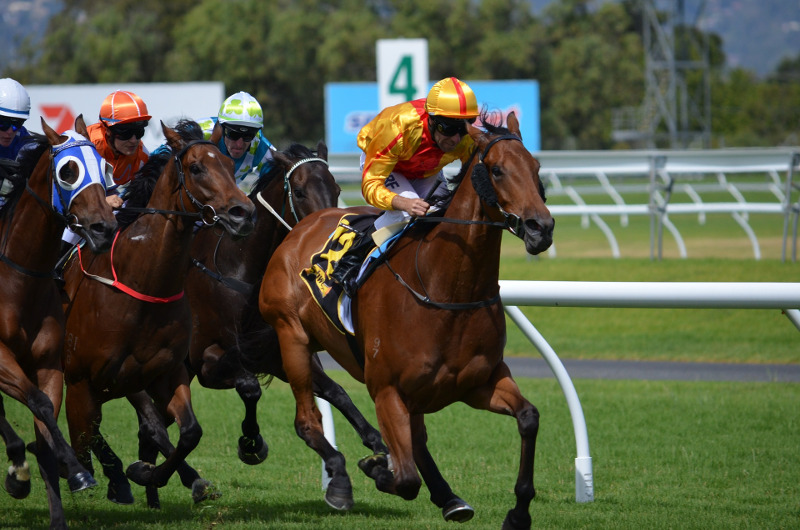
Quick Strike the Latest Victim of Horse Racing
Animals Tasmania are renewing the call to end horse racing following the death yesterday of Hobart Cup starter Quick Strike.
“We are deeply saddened to learn of the death of Quick Strike as a result of yesterday’s Hobart Cup. Read More
 Bychris
MEDIA RELEASE
8 February 2016
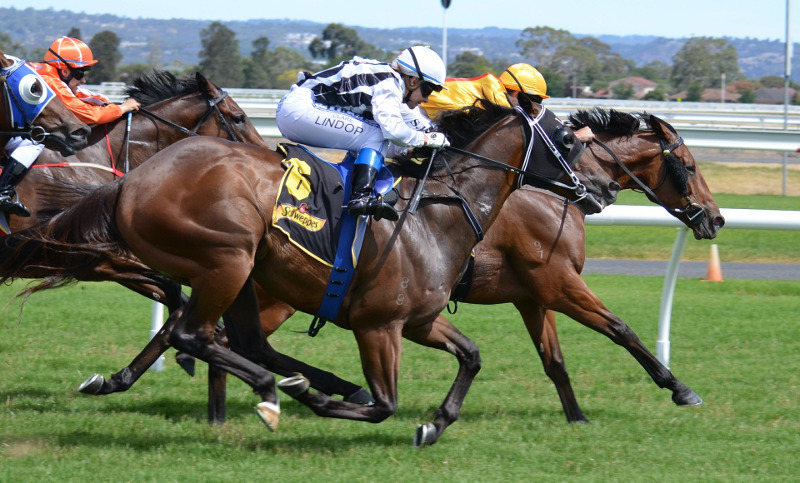
Stop Abuse of Horses in Racing
Action at Hobart Cup
Animals Tasmania want to see an end to the needless exploitation of horses used in racing. This is part of a wider call for an end to the treatment nonhuman animals as property. Read More
 Byanitasm
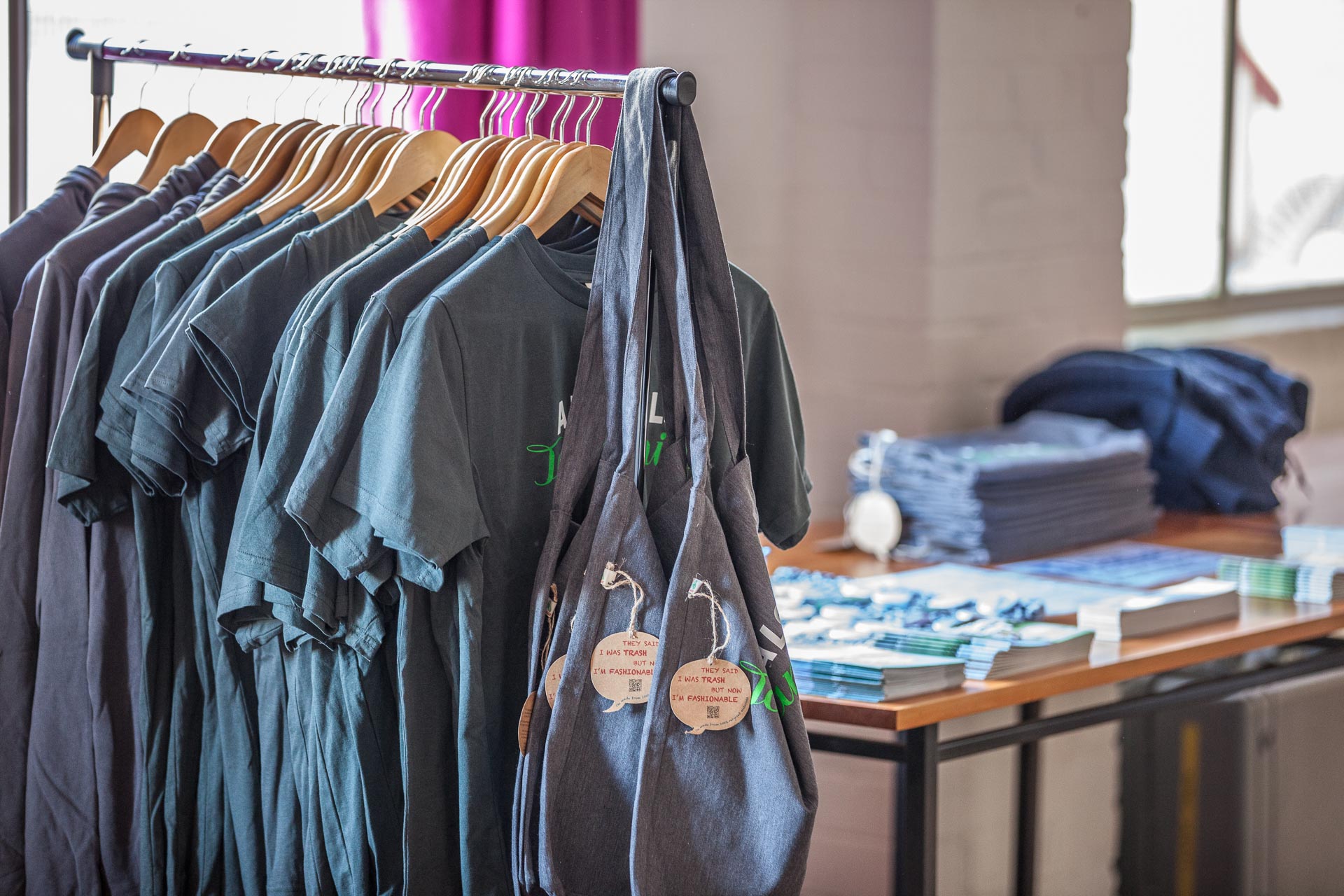
Animals Tasmania is proud to launch our new website. The new site has been designed with simplicity and the Animals Tasmania aesthetic in mind.
We are also proud to launch our new online shop, online memberships and donations.
Thanks for your ongoing support!
 Byanitasm
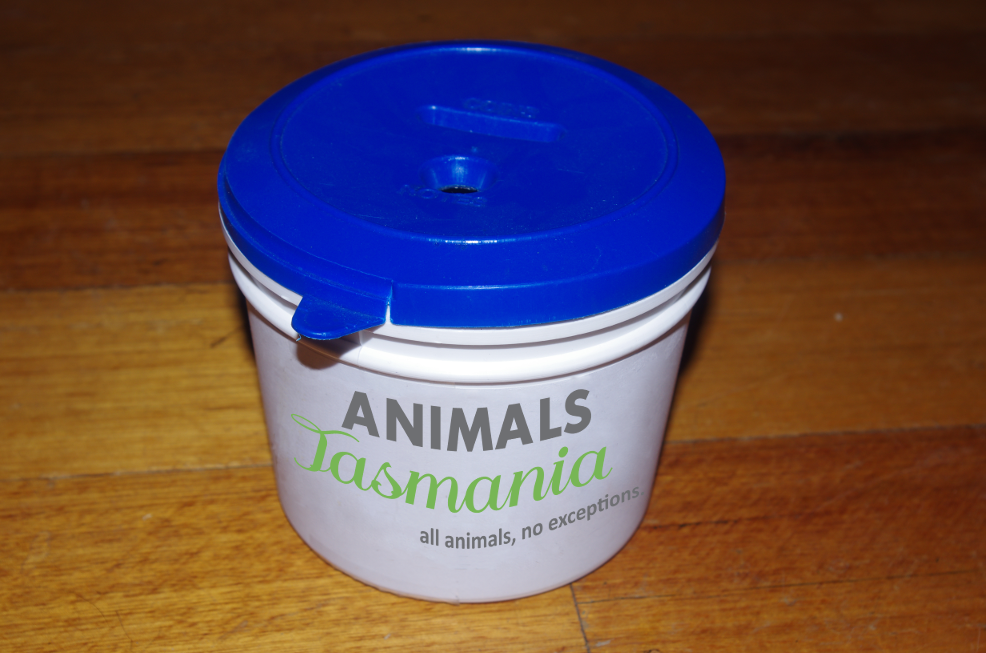
Animals Tasmania is having our annual tin shake on Friday the 16th of October from 9am to 5.30pm!!
This is our biggest fundraiser for the year and we would love as many volunteers as possible to help us make it a huge success.
There will be tin shake coordinators in Hobart and Rosny Park (Eastlands) and we would appreciate a donation of time by any of our valuable supporters on this day. Whether half an hour or half a day, your time will be greatly appreciated.
Are you working that day? Arrange to collect a tin from us and take it to work.
As an organisation we are working to provide better protection for all animals in Tasmania. With your generous support we can help to improve the lives of many animals every day of the year.
Please contact us if you are able to lend some of your valuable time to help us help animals. We still have opportunities for collections to happen in other areas. If you are interested in increasing the effectiveness of our collection efforts, get in touch!
 Byanitasm
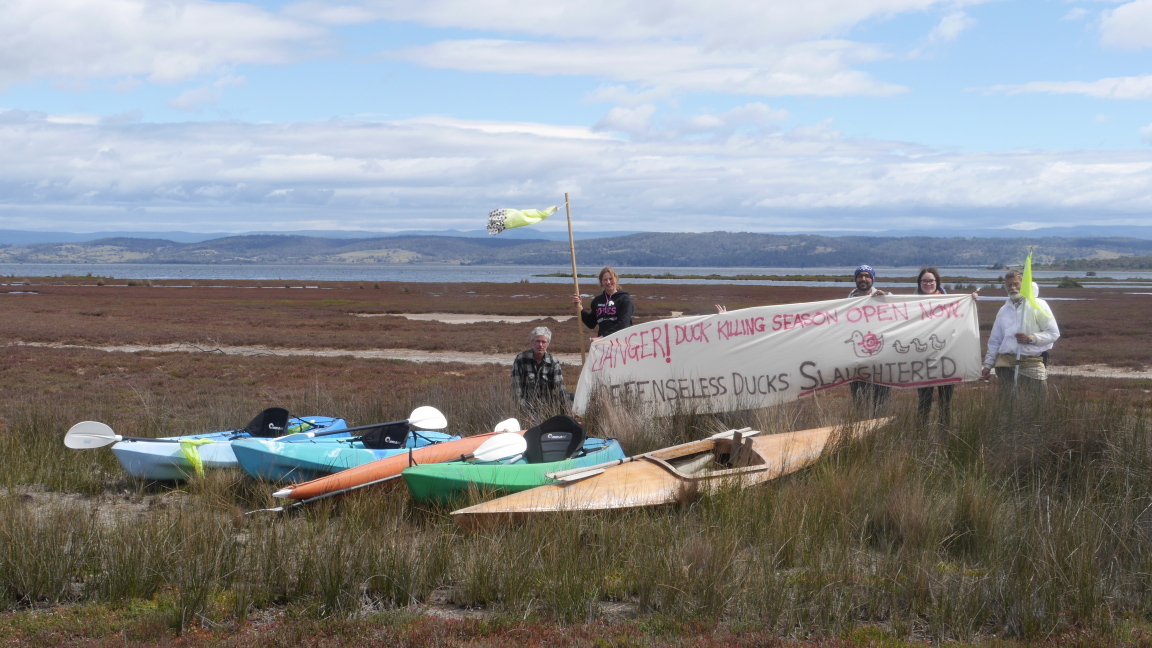
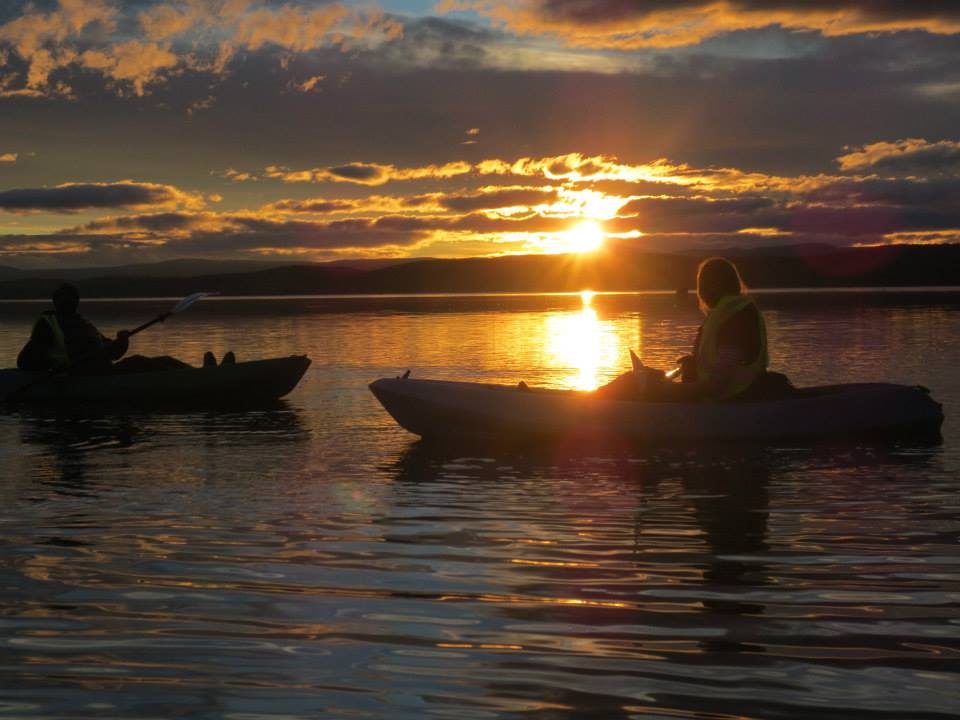
In March this year, Animals Tasmania activists spent their weekend rescuing ducks for the opening of the duck-killing season at Moulting Lagoon. Here is the story:
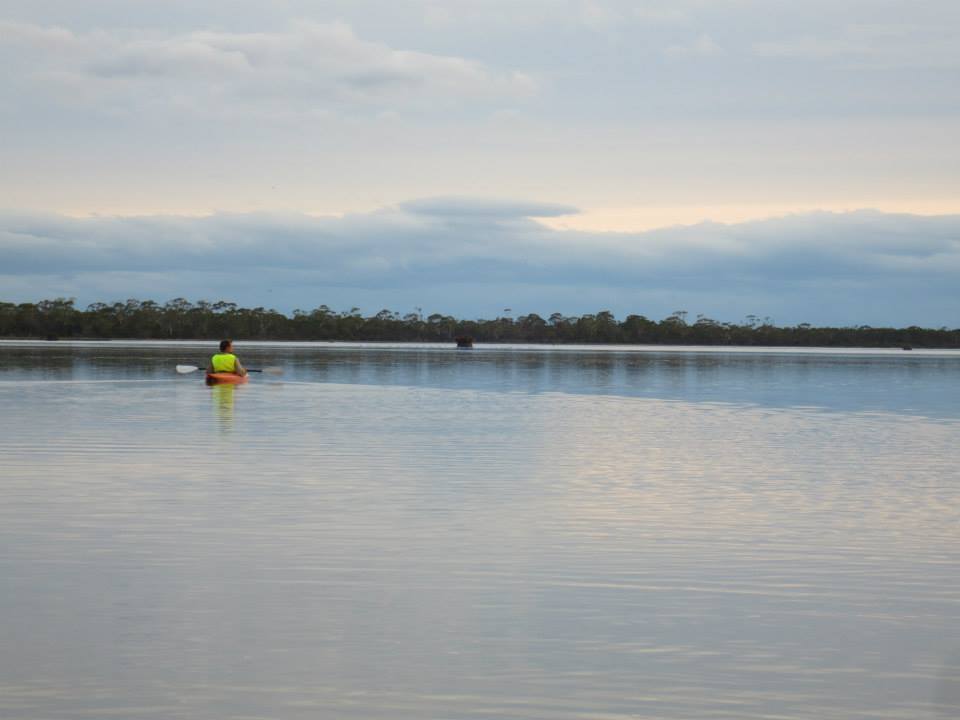
A small group of us arrived at the campsite in the dark late Friday night after a three hour drive up the East Coast of Tasmania. We set up camp and went to bed early for a 4.30am start. We awoke with the moon still high in the sky, ate breakfast, donned our thermals and dragged our kayaks to the water by 5.30. We needed a head torch to make our way safely to the edge of the lagoon but already we were hearing the first of the gunshots resounding through the silent bay. Legally hunters are allowed to start shooting 1 hour before sunrise, this is interesting as there are many ‘non-target’ species of bird in the lagoon, many ‘illegal’ or protected species. At this time we couldn’t see two metres in front of us, much less determine mountain ducks from spoonbill ducks and swans. We climbed into our kayaks and made our way through the perfectly still water. There is an ethereal quality to sailing through such still water at that time of day.
We soon found our way to the first of the small hunting hides that punctuate the stunning lagoon. A hide is a small structure built on stilts just above the water, it is disguised with dead branches and the top is open so that a hunter can stay completely hidden while aiming a gun at unsuspecting birds. You can tell which hides the shooters occupy because they are surrounded by ‘lures’. The lures are floating, life-like duck mannequins that the shooters arrange so as to resemble a flock of ducks safely swimming around the hide. The purpose of these lures is to entice the trusting ducks that are passing by to fly down and land near the hide among ‘their kind’. Our job as activists and duck rescuers was to kayak near the occupied hides wearing high visibility clothing and attempt to divert the birds out of range of the shotguns. To do this we would use whistles and movement to signal to the ducks that the area wasn’t safe so they would fly higher and divert away from the hidden danger. The shot guns have a range of 50 metres and work by releasing a spray of small steel pellets that span out to cover a wide ‘kill spread’ when aiming at a group of birds. This is helpful for hunters because they don’t require a lot of skill to hit a bird. It is awful for the ducks because for every one who may be mortally injured there may be ten ducks that suffer injuries from these pellets that allow them to get away. Many are disabled and die slowly over the coming two to three days. It isn’t uncommon to see a group of ducks flying in a beautiful V formation over the hides, to hear a shot, and then to see one or two of the group suddenly jerk as if they have been hit and continue flying. For these reasons, our main objective as rescuers was to peacefully divert the ducks out of range of the shotguns to protect them from both mortal and sub-mortal injuries.
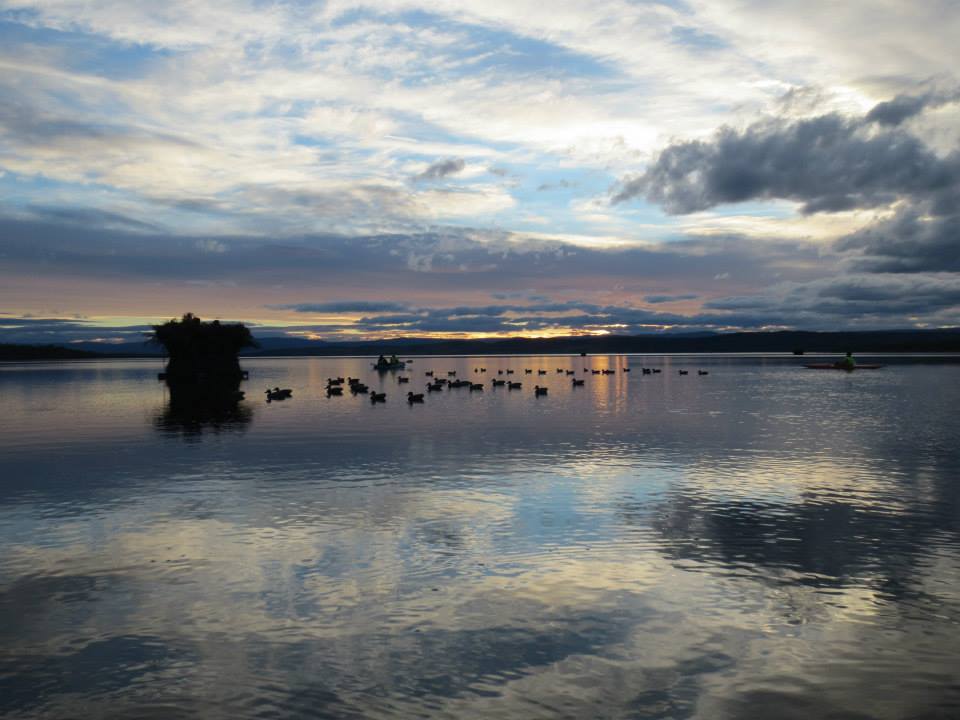
A hide surrounded by lures on moulting lagoon
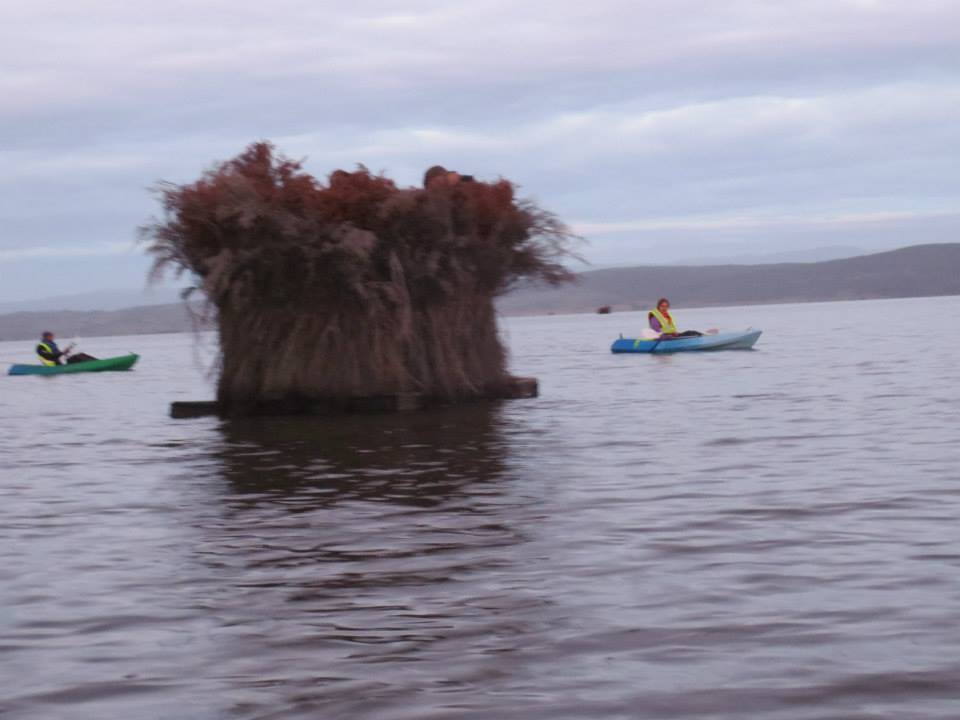
Warning ducks away from the hides
Another method that we employed to save birds was to chat to the hunters about what their motivations were for shooting the birds in the pristine lagoon. We received varied responses from the shooters. Some explained that they came to the lagoon for a sense of tradition, that they were the fifth generation to take lives in their particular hide. Unfortunately however some of the most harmful words throughout history have been ‘it has always been done this way’. Other shooters explained that they had a deep love of the environment. This is understandable; the lagoon is pristine, nearly untouched raw Tasmania. The water reflects the sky and is dotted with flocks of graceful black swans and the occasional regal pelican, only marred by the numerous hides disturbing the natural banks. Flocks of ducks form V formations overhead and both the sunrise and the sunset light up the sky in an incredible display of pinks and orange.
Moulting lagoon at sunset
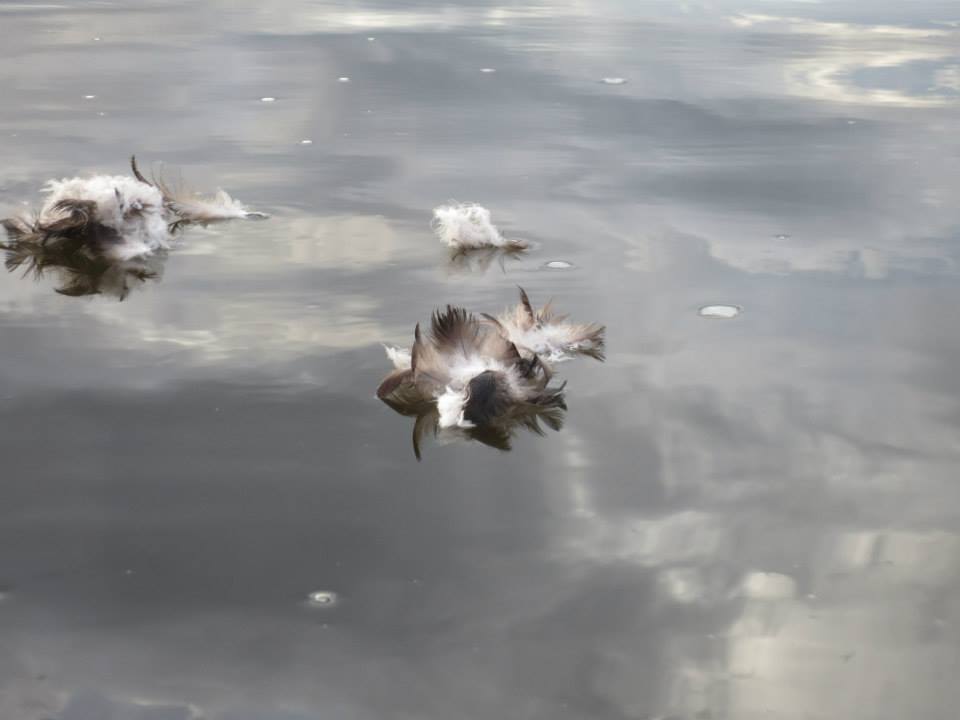
This, however, doesn’t explain the need to cover the soundtrack of swans honking and birds singing with the shocking boom of shots fired, to rearrange the V formations by removing group members or why one would want to disturb the glassy waters with clumps of feathers ripped from a trusting duck’s still-warm body. I might suggest one could perhaps enjoy the spectacular environment all the more should they replace the loud and violent shotgun with a quiet and kind camera and binoculars.
Of course, not all of the responses we got were so civil. We were sworn at and called all forms of atrocities. There were jeers and there were, interestingly, death threats. One of our activists was threatened with a shot gun aimed at her chest and was told by the men that they would push her out of her kayak. She felt the need get out of her kayak for her own safety and as a result risked drowning in the muddy bottom of the lagoon. Three more of us were threatened, told that we would get a bullet between the eyes and that the shooter would ‘spear’ us, cave our heads in with a rock and numerous other horrific threats including rape of our female activists. This shooter proceeded to throw large rocks at us and threatened us with death should we touch any of his decoys, something we never intended to do. We were simply kayaking in a public lagoon, occasionally we would blow our whistles and splash the water. Everything that we were doing was legal and we received numerous death threats from those that held gun licenses and loaded weapons. In Tasmania we issue over 1000 duck hunting licenses every year, this license gives the shooter the right to kill a maximum of 10 ducks per day throughout the season. The duck-shooting season lasts for three months. Doing some quick math, if a hunter was particularly motivated and ‘skillful’, it would be legal for him or her to kill 10 ducks a day for approximately 90 days. 900 ducks a season. As we issue 1000 licenses each year we legalise the killing of 900,000 ducks in Tasmania every year over one quarter of the year. This is without taking into account those injured that the hunter doesn’t get to collect that don’t then move him towards his bag limit. It should also be noted that several duck species are monogamous and only take one partner for life so when one is shot the other is incapable of going on to breed.
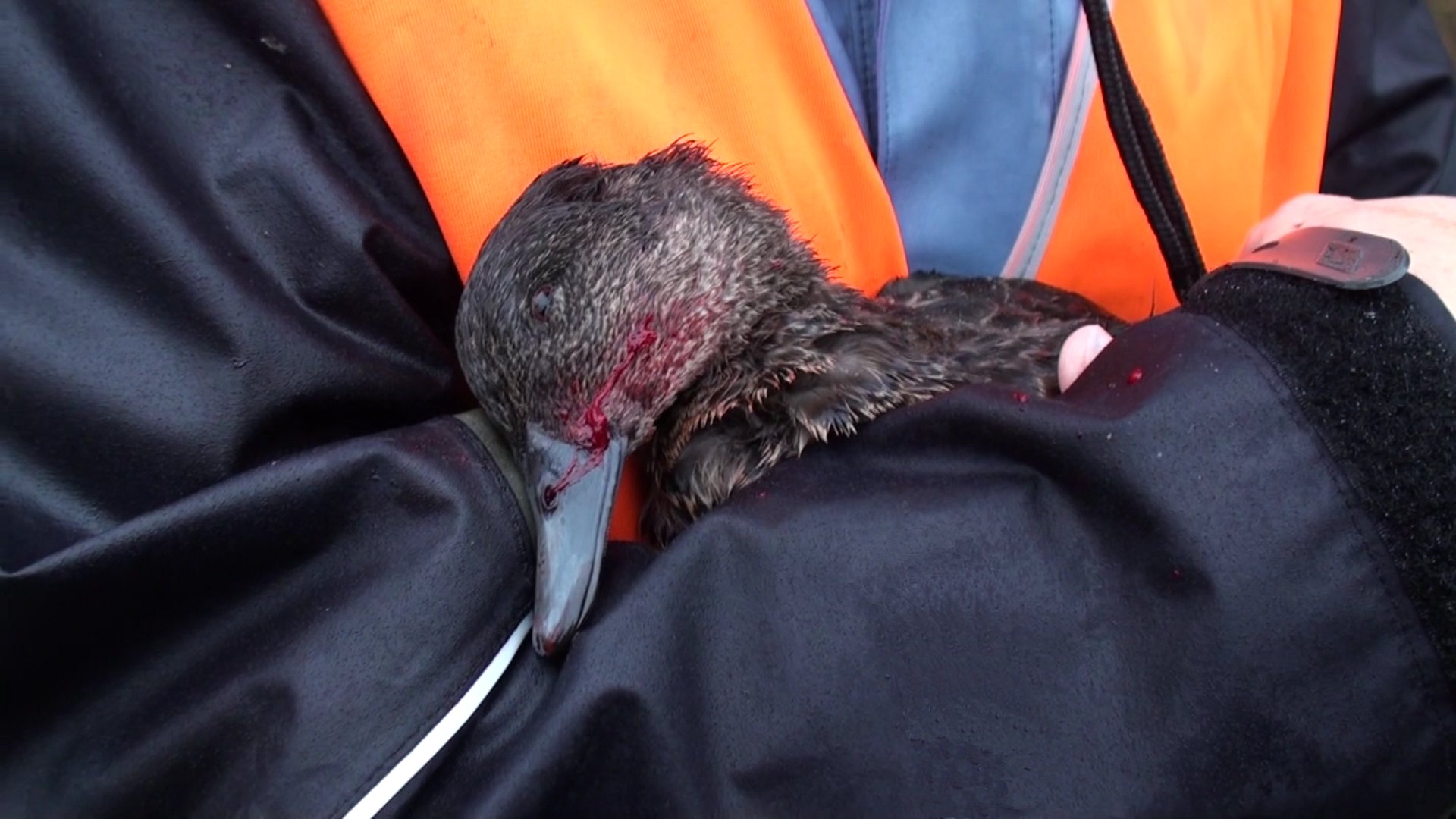
One of of our activists cradles a victim of the open season
I suppose one shouldn’t be surprised by this, let’s call it, ‘inhibition’ as some of the members of our group heard the very regular sound of empty cans being dropped inside the hides they were guarding and when we cleaned up a small portion of the bank of the lagoon on the last day we picked up a bag full of empty beer cans and plastic rings from six packs amongst the many non-biodegradable shot casings littering the shore. This calls into question the arguments about hunters being the ‘true conservationists’ and doing it for a love of the environment.
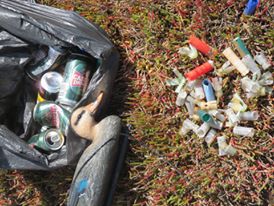
Cleaning up the shores of Moulting Lagoon
Duck hunting is a cruel pastime that inevitably stresses sensitive water-bird populations, that has no guarantee of accuracy or mortality and leaves many animals maimed, to die slowly over coming days and the number of ducks that may legally be killed is unsustainable. The law in no way guarantees that protected species won’t be harmed and the reasons of tradition and ‘conservation’ are tired excuses for ‘big men’ compensating for something. Our public camping grounds and pristine local travel destinations are marred with violence towards animals as well as danger to the general public and death threats to those legally attempting to enjoy the pleasures of the lagoon. Duck hunting is already illegal in several Australian states and Tasmania is the next place that needs to make this legislative move. Until we do duck hunting is marring our tourist destinations and will remain one of Tassie’s great shames.
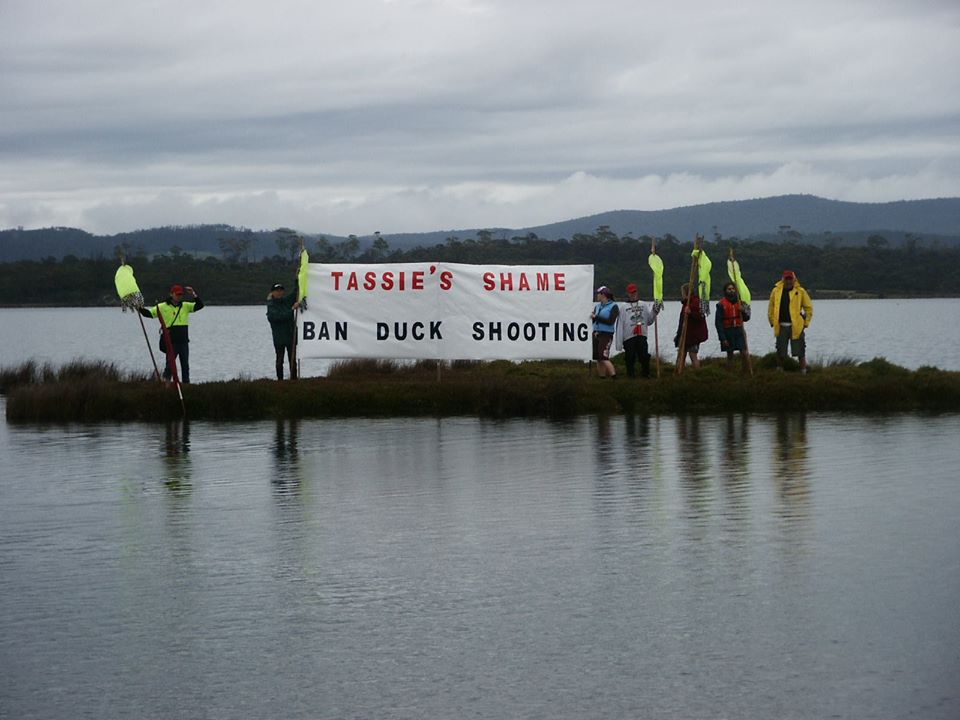
Ban duck shooting!
 Byanitasm
A lecture on fish pain and cognition by eminent scientist Associate Professor Culum Brown of Macquarie University and the philosophy of fishing by PhD candidate Larelle Bossi of UTas.
We had a great turnout, around 70 people, which filled the lecture theatre, and considering the short notice of the event, it was fantastic to see this many people interested in learning more about fish.
A/Prof. Culum Brown began the evenings lecture by explaining why he chose fish for his research, this included commercial fisheries, aquaculture, companion animals (humans have as companions more fish than dogs or cats) scientific research (fish are next most used after mice and rats) and vertebrate diversity. It was amazing to hear that 54% of vertebrates are fish.
Culum explained that there exists a huge gap between the public’s perception of fish and the scientific knowledge of fish intelligence, and how he is trying to help change that perception.
Culum’s discussion then turned to a fish’s cognitive ability and how smart fish are, highlighting that they are definitely not primitive, but ancient and highly evolved. Fish are 500 million years old, which actually gives them a 350 million year head start on mammals. Fish have all the same behavioral capabilities of mammals, such as learning and memory, tool use, social learning, cooperation, culture, reconciliation, nest building, plus more. All findings from his research studies.
A fish has the ability to perceive pain and this is due to pain receptors that are the same as ours, physiologically; scientists have known this for over 10 years. A fish’s brain has all the same functional parts that other animals have, Culum explained. Behavioural cues tell us pain is being felt by a fish: a change in behaviour post stimulus; morphine returning changed behaviour to normal; fish avoid objects associated with pain and fear; when pain is anticipated stress levels increase and cortisol appears; and brain parts for the emotional response to pain are present. (The claim that pain response is only observed in the neo cortex, is an argument that only human beings feel pain. Pain response actually occurs in other parts of the brain too!)
Culum touched on many profound points about fish during his lecture. The following are two which are worthwhile pondering on – “It is hard for us to relate to fish, as they live in a different world, therefore it is hard to empathise with them” and “Humans are fish, with a few genes tweaked”.
He concluded his concise and clear talk by saying that he leaves it up to us to make up our minds about fish, and considering what we now know, to think about this question: Should we include fish in our circle of moral concern?
Our next speaker Larelle Bossi, had a philosophical view that added an intriguing touch. Larelle’s discussion began by looking at many examples of how throughout history and in many cultures we have used fish as important symbols, such as goddess Visica Piscis, Aphrodite, Freya and Pisces. Fish symbolism is an example of how humans have repeatedly looked at fish as sacred to our being and to our mother earth.
Larelle explained that we need to construct an entirely different view of our natural world and that we need to change our perspective to one that includes humans as part of nature, removing the focus away from humans. Larelle concluded that without this change in perspective, even with the science, we will not make that shift to include fish as part of our circle of moral concern.
There were many questions posed by the audience at the end of the lecture, and a lot of interest and discussion between people. Applause was given all around to our fantastic speakers who gave their time to help educate us about the true nature of fish. We thank Culum and Larelle for flying to Tasmania and sharing their knowledge.
We hope that this is one small step towards the inclusion of fish in our circle of moral concern, as this is where they deserve to be, with all the animals, human and non-human with whom we share this planet.
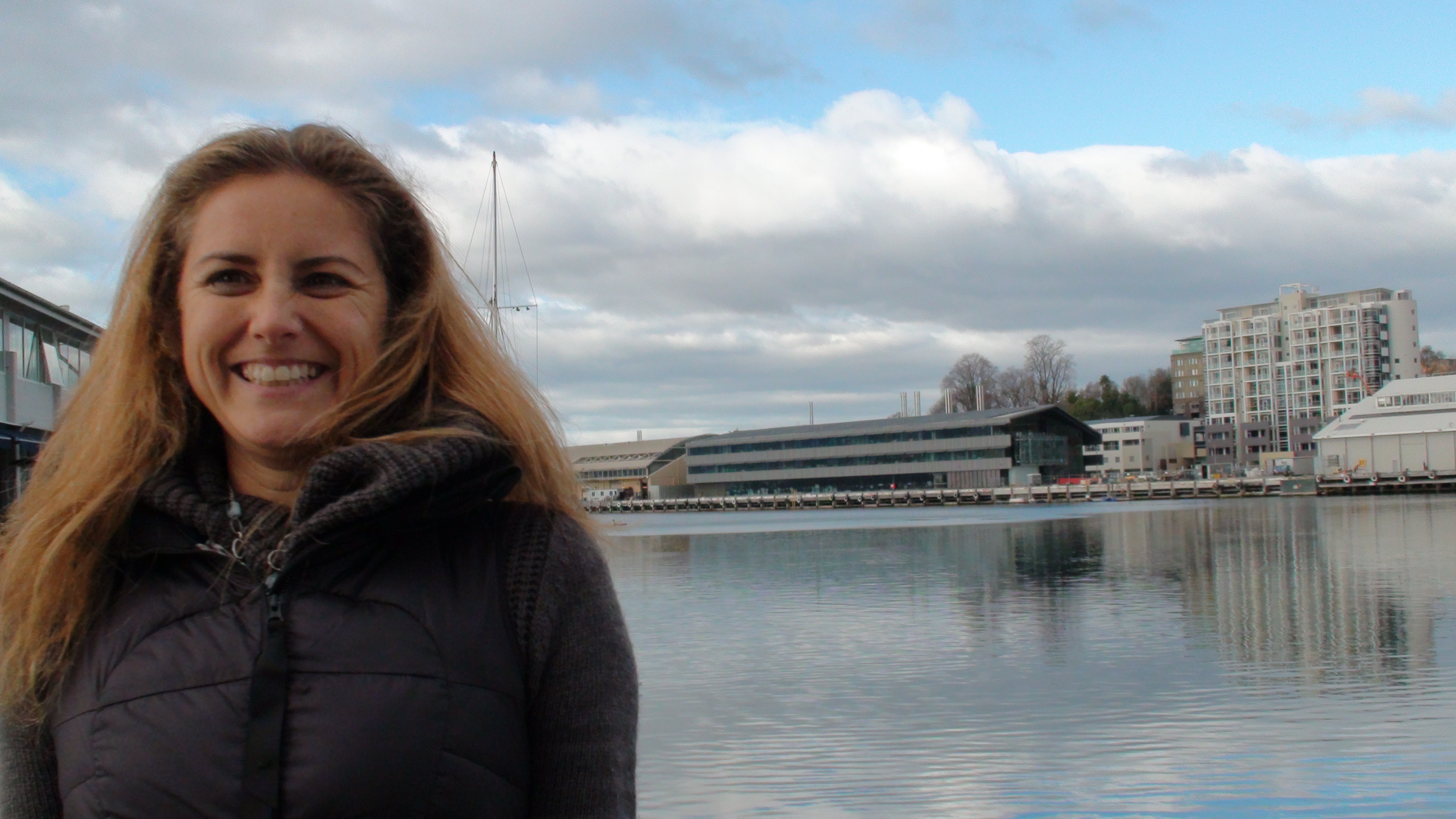
Larelle at Hobart waterfront, giving an interview.
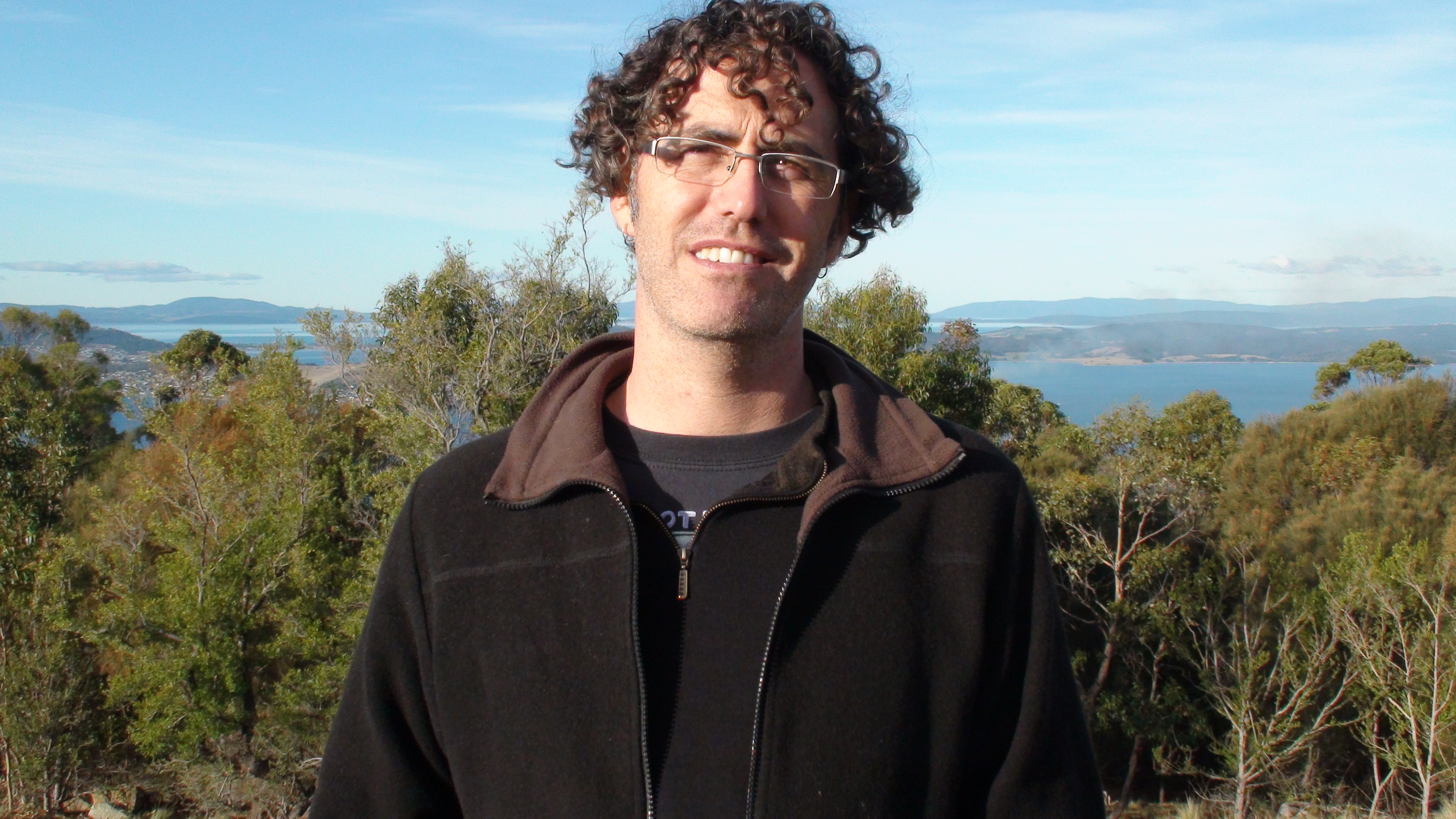
Culum at Mt Nelson, Hobart, giving an interview.
 Byanitasm
Animals Tasmania is the new face of animal advocacy in Tasmania. We are there to speak for non-human animals in Tasmania and beyond. All animals, no exception.
